
BRUSSELS, BELGIUM – As air travel, cross-city journeys and business trips become increasingly common, moving through airports, railway stations and large exhibition centers often involves considerable walking and frequent transfers. For travelers carrying luggage, these journeys can be physically demanding. This has created new opportunities for innovation in the traditional luggage industry.
The smart riding cabin suitcase is one response to this evolving travel landscape. By integrating an electric drive system and a rideable structure into conventional luggage, it combines everyday storage with short-distance personal mobility. Rather than simply being pulled from one destination to another, a suitcase can also become an intelligent travel companion that helps users move more conveniently in suitable environments.
With more than 600 global patents, Airwheel has been exploring the intersection of smart mobility and traditional luggage. Through ongoing development in power systems, mechanical engineering and intelligent control, the brand continues to advance the design and functionality of smart riding suitcases.
1. What Is a Smart Riding Luxury Suitcase? Airwheel’s Journey Begins with SE3 Scooter Suitcase
What makes a smart riding electric suitcase different from conventional luggage?
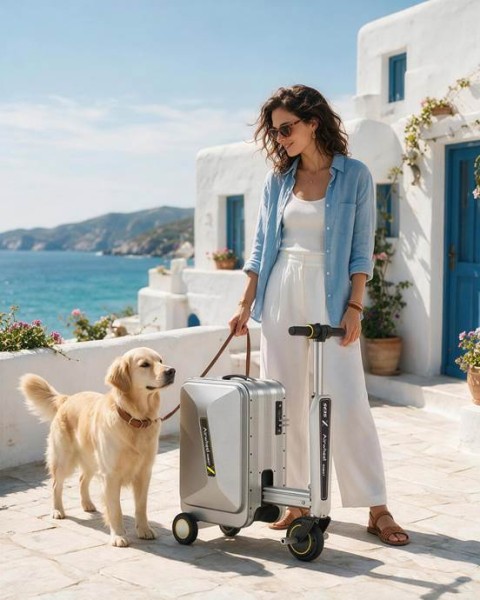
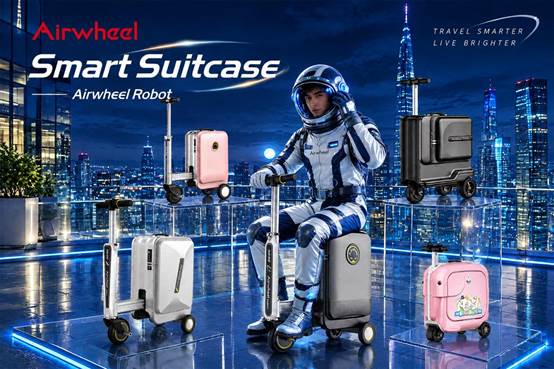
A traditional suitcase relies on wheels and a telescopic handle for manual pulling. A smart riding suitcase retains the essential function of luggage storage while adding an electric drive system and a riding mechanism. When the riding structure is deployed, users can ride the suitcase for short-distance transportation. When riding is not required, the mechanism can be folded away, allowing the suitcase to return to its conventional towing mode.
This combination expands the role of luggage from a passive carrier of personal belongings into a mobility product with additional functionality.
Integrating an electric drive system and a riding mechanism into a compact suitcase is a complex engineering challenge. Designers must balance motor performance, structural stability, storage capacity and ease of operation. The riding components must deploy smoothly and lock securely, while remaining compact enough to be stored when not in use.
Airwheel began exploring this product category with its SE3 smart riding suitcase. The early SE3 brought together an electric drive system, a retractable riding handle, electronic braking and smartphone app control, demonstrating how personal mobility technology could be integrated into a traditional luggage format.
The SE3 marked an important step in Airwheel’s development of smart riding luggage. Since then, the company has continued to refine its riding mechanisms, drive systems and user interfaces, gradually building a product portfolio for adults and children, including both 20 inch suitcase and larger checked-luggage models.
2. Advancing the Technology: Making Smart Features Practical for Everyday Travel
The value of a smart suitcase goes beyond adding an electric riding function to traditional luggage. Its development is ultimately about making that function more practical, intuitive and adaptable to real travel situations.

From Manual Deployment to One-Touch Electric Extension
The riding mechanism is one of the defining features of a smart riding suitcase.
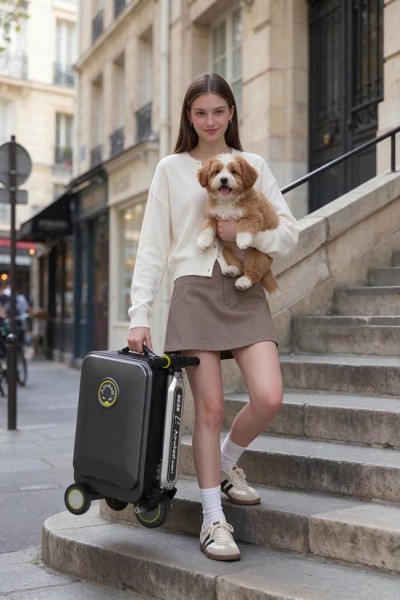
In earlier designs, users needed to manually extend the riding handle and complete the locking process before riding. As the product range evolved, Airwheel introduced automatic locking mechanisms to simplify operation.
The Airwheel SE3SXD Ai Suitcase flagship model takes this development further with an electric dual-extension system.
With a one-touch operation, the motorized front wheel and riding handle can extend and lock into position. After riding, users can activate the retraction function to fold the components back into the suitcase. This allows the product to switch between riding and conventional luggage modes more conveniently.
The progression from manual deployment to automatic locking and then electric dual extension reflects Airwheel’s ongoing work to improve mechanical integration and the overall user experience.
Smart App Control and Apple Find My Support
Smart interaction is another important part of Airwheel’s product development.
Selected premium models are equipped with a dedicated mobile app, allowing users to access product information and use model-specific functions. Depending on the model, these may include speed adjustment, lighting settings, remote control and cruise control.
Selected models, including the SE3SL+ Boarding Airport Suitcase, SE3SX Cabin Suitcase and SE3SXD Ai Luxury Suitcase, also support Apple’s Find My network, providing an additional way to help locate a suitcase.
By combining mechanical innovation with connected features, Airwheel is bringing the interaction capabilities of smart hardware into the traditional luggage category.
Removable 73.26Wh Battery for Greater Travel Flexibility
Battery design is a key consideration for any electric suitcase, particularly when the product is intended for air travel.
Selected Airwheel 20-inch adult smart riding suitcase models use a removable 73.26Wh lithium-ion battery. The modular battery design allows the battery to be detached from the suitcase, giving travelers greater flexibility when managing the product in accordance with airline requirements.
Airwheel’s 20-inch models are designed around the dimensions commonly associated with cabin-size luggage, while the 24-inch SE3T Ai Wheel is a larger checked-luggage model. For checked luggage, the battery must be removed and handled according to the applicable airline’s procedures.
3. What Should Travelers Know Before Choosing a Smart Riding Suitcase?
Beyond design and technology, practical questions such as riding range, speed, load capacity and suitable environments are important when evaluating a smart riding suitcase.
How Far Can an Airwheel Smart Riding Suitcase Travel on One Charge?
According to Airwheel’s product specifications, most adult models offer an estimated riding range of approximately 8 kilometers on a full charge. The larger 24-inch SE3T has an estimated range of approximately 6 kilometers.
These figures are intended for short-distance mobility, such as moving through airport terminals, railway stations, exhibition centers and hotel environments.
Actual range may vary depending on rider weight, surface conditions, ambient temperature, riding speed and usage habits. Low temperatures and heavier loads, for example, may reduce the distance achievable on a single charge.
How Fast Can Different Models Travel?
Airwheel offers different speed configurations across its product range to accommodate different product designs and user requirements.
- SE3S and SE3T: Maximum speed of up to 13 km/h.
- SE3miniT: Maximum speed of up to 8 km/h.
- SE3SL, SE3SL+, SE3SX and SE3SXD: Maximum speed of up to 9.9 km/h.
- SQ3: Maximum speed of up to 5 km/h.
- SQ3S: Maximum speed of up to 6.5 km/h.
The children’s models use lower speed configurations. Regardless of the model, riders should adjust their speed to pedestrian traffic, surrounding conditions and local venue regulations.
What Is the Maximum Riding Load?
Riding load refers to the maximum rider weight supported by the suitcase when used in riding mode. It is different from the amount of luggage the suitcase can carry internally.
According to Airwheel’s specifications, the maximum riding loads vary by model:
- SE3S, SE3T and SE3miniT: Up to 110 kg.
- SE3SL, SE3SL+, SE3SX and SE3SXD: Up to 95 kg.
- SQ3 and SQ3S: Up to 40 kg.
Travelers should check the specifications of their chosen model and follow the corresponding product instructions.
Where Is a Smart Riding Suitcase Best Used?
Airwheel smart riding suitcases are designed primarily for short-distance travel on flat, paved surfaces, where riding is permitted.
Potential use cases include:
- Moving through large airport terminals.
- Short-distance transfers in railway stations and transport hubs.
- Hotel and business travel environments.
- Large exhibition and convention centers.
- Other paved areas where electric riding devices are permitted.
When riding is unsuitable or not permitted, users can retract the riding mechanism and move the suitcase in conventional towing mode.
Steep slopes, grass, gravel, stairs and wet or slippery surfaces are not recommended for riding. Airwheel models use an electronic braking system with a buffered braking process rather than an emergency-stop function. Riders should maintain a controlled speed, remain aware of their surroundings and follow the product’s safety instructions.
4. A Diverse Product Portfolio for Different Travel Needs
Through continued research and product development, Airwheel has established a product portfolio that includes 20-inch adult cabin-size models, a 24-inch checked-luggage model and smart riding suitcases for children.
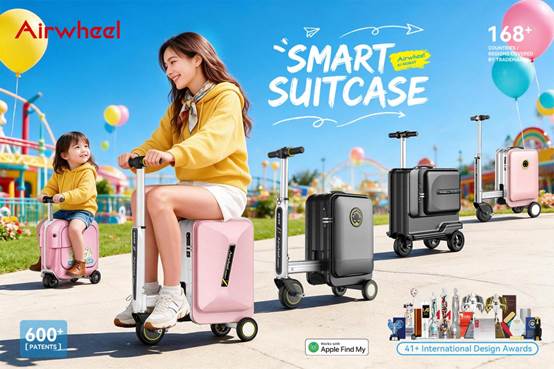
20 Inch Adult Smart Cabin Suitcases
The 20-inch range is a central part of Airwheel’s smart riding suitcase portfolio. These models are designed for travel scenarios such as airports, railway stations, business trips and exhibition centers.
The Airwheel SE3SXD Ai Luxury Suitcase represents the flagship direction of the range. It features an electric dual-extension system that allows users to deploy or retract the riding components with one-touch operation. It also supports a dedicated mobile app and Apple Find My, with a maximum riding speed of 9.9 km/h.
The SE3SX features an electric retractable front-wheel design, app connectivity and Apple Find My support. Its maximum riding speed is also 9.9 km/h.
The SE3SL and SE3SL+ offer alternative configurations for different user preferences. The SE3miniT adopts a lightweight, non-retractable front-wheel structure designed for flat surfaces, while the SE3S offers a maximum riding speed of up to 13 km/h.
Together, these models provide different combinations of riding performance, mechanical design and smart functionality.
24 Inch Smart Checked Suitcase
For travelers who need more storage capacity, the Airwheel SE3T offers a larger 24-inch format.
The model provides 48 liters of storage capacity and features a 250W motor, a maximum riding speed of 13 km/h and a maximum riding load of 110 kg.
By combining a larger luggage compartment with short-distance electric mobility, the SE3T offers another option for business trips and longer journeys. As a checked-luggage model, its removable battery must be handled in accordance with airline requirements.
Smart Riding Suitcases for Children
Airwheel also extends the smart riding suitcase concept to family travel through its SQ3 and SQ3S children’s models.
The SQ3 is designed for children aged 3–6, while the SQ3S is designed for children aged 5–8. Both feature lower-speed configurations and incorporate features such as Bluetooth audio and lighting to create a more engaging travel experience.
With products for adults and children, Airwheel continues to explore a wider range of applications for smart riding luggage.
5. Global Presence: Bringing Smart Mobility Innovation to International Markets
Founded in 2004, Airwheel follows the brand philosophy of “Free Intelligent Life ” The company focuses on the research, development and innovation of smart mobility products, bringing electric drive technology, intelligent control and industrial design into everyday transportation and travel products.
Its technology development covers areas including motion control, electric drive systems, intelligent sensing and structural engineering. According to Airwheel’s published company information, the brand has accumulated more than 600 global patents, including over 180 patents directly related to smart luggage.
Airwheel products are available in 68 countries and regions, supported by a global retail network of more than 4,600 retail terminals.
The brand has also received recognition in international design and innovation programs, including the US-based IDEA and MUSE awards, IDA, the French Design Awards and the Berlin Design Award, among others. These recognitions reflect Airwheel’s continued exploration of product design, structural innovation and smart mobility experiences.
For an international brand, expanding into new markets involves more than increasing product availability. It also requires an understanding of different consumer expectations, airline transportation policies and public-space regulations. Airwheel continues to develop and refine its products with the needs of different markets and travel environments in mind.
6. From Smart Luggage to the Future of Travel
The evolution of luggage—from handheld cases to wheeled suitcases and telescopic-handle designs—has continually changed the way people carry their belongings.
Smart riding suitcases represent another step in this evolution by expanding what traditional luggage can do.
For Airwheel, innovation is not simply about adding more features. It is about applying technology to practical travel challenges and developing products that respond to the way people move through the world.
As travel habits and mobility technologies continue to evolve, Airwheel will keep exploring new possibilities for intelligent hardware in travel and everyday life.
A suitcase can be more than a way to carry belongings. It can become an intelligent companion that connects technology with the journey ahead. This is the direction Airwheel continues to explore.
About Airwheel
Airwheel is a smart mobility brand founded in 2004, dedicated to the research and development of intelligent mobility products. By integrating electric drive technology, intelligent control systems and innovative industrial design, Airwheel develops products that bring new functionality to modern travel and everyday transportation.
Its portfolio includes smart riding suitcases and other intelligent electric mobility products. With a presence in 68 countries and regions, Airwheel continues to advance its work in motion control, electric drive systems, intelligent sensing and product engineering, with the aim of making travel and mobility more convenient through smart technology.
Media Contact
Company: Airwheel
Contact: Media Team
Email: Jonas@airwheel.net
Website: https://www.airwheel.net
Disclaimer: The views, suggestions, and opinions expressed here are the sole responsibility of the experts. No Just Examiner journalist was involved in the writing and production of this article.
