
-
The company is extending its city-by-city deployment strategy to one of the United States’ most active tourism markets, where seasonal demand and diverse travel patterns offer a new operating environment for the ER-BX series.
Bishopsgate, London, Sep 14, 2026, ZEX PR WIRE — Following phased operational progress in Austin and Los Angeles, autonomous mobility technology company Carziqo has introduced its ER-BX autonomous ride-hailing series in Miami, marking the latest step in the company’s expansion across major US cities.
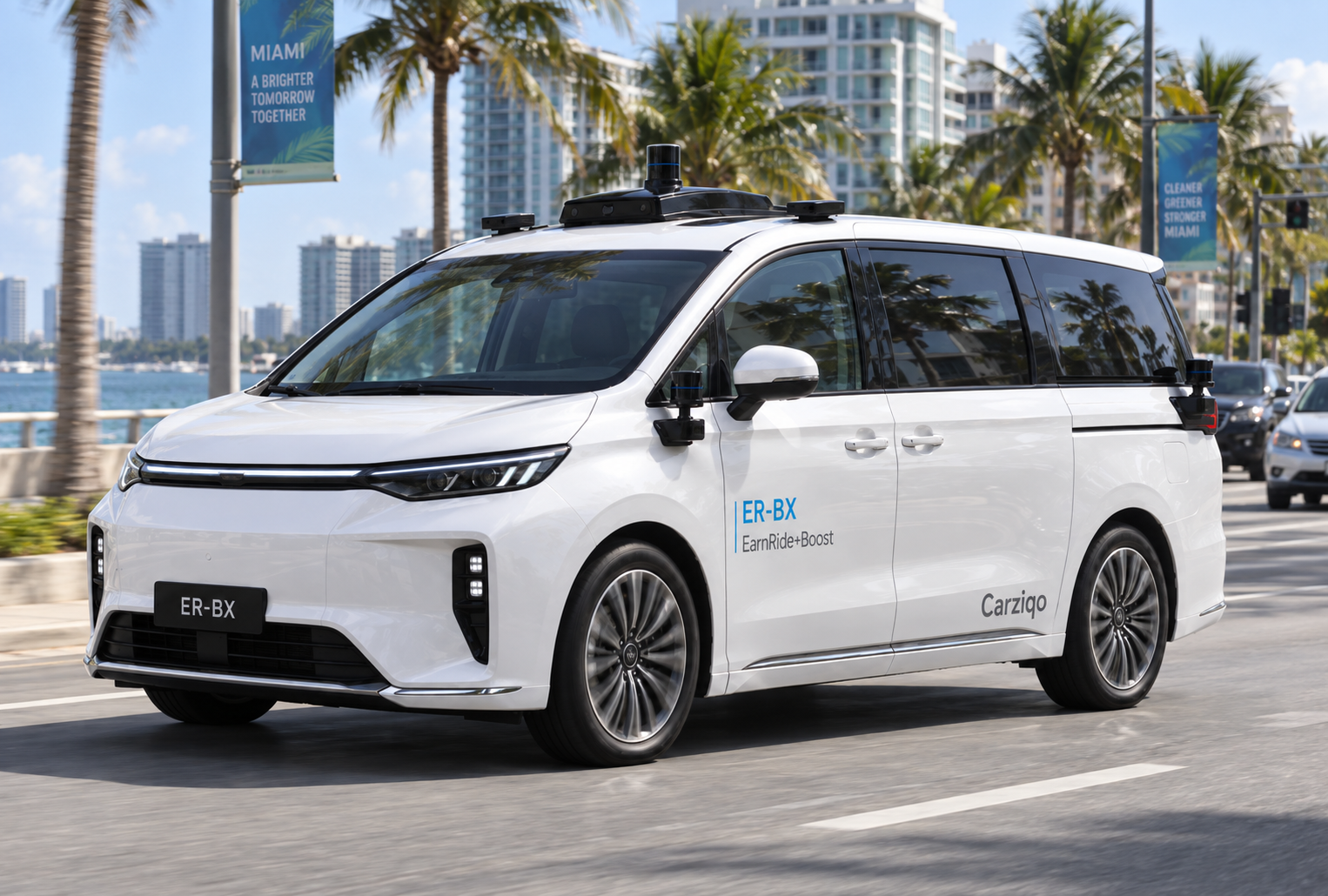
The Miami deployment builds on the experience Carziqo gained while operating the ER-BX series in two distinctly different urban environments. Austin provided an opportunity to assess the vehicles in a fast-growing technology hub characterized by expanding residential districts and evolving mobility needs, while Los Angeles offered exposure to a larger and more complex transportation landscape shaped by long travel distances, dense commercial areas and varying traffic conditions.
Carziqo said the initial phases in both cities generated operational insights that are now being applied to the ER-BX rollout in Miami. These include vehicle scheduling, route allocation, demand forecasting, fleet monitoring and service coordination across different periods of the day.
Rather than treating each new city as an identical market, the company is following a city-specific approach. Deployment plans are adjusted according to local travel behavior, operating conditions, service availability and passenger demand.
A New Environment for the ER-BX Series
Miami presents a particularly relevant setting for autonomous ride-hailing operations because of its combination of tourism, hospitality, residential communities, business districts and major transportation connections.
Daily mobility demand in the city is influenced not only by local commuters but also by visitors traveling between hotels, commercial centers, entertainment districts, airports and other popular destinations. Demand can change significantly according to the time of day, tourism season, weather conditions and major events.
For Carziqo, this creates an opportunity to evaluate how the ER-BX series performs in a market where passenger movements are highly varied and often time-sensitive.
The initial Miami phase will focus on gradually integrating ER-BX vehicles into selected operating areas and mobility scenarios. Carziqo said service coverage and fleet allocation may be adjusted as the company collects additional operational data and evaluates local demand.
The company is also expected to assess how vehicles can be positioned more efficiently during periods of increased visitor activity. Intelligent dispatching and demand-based fleet allocation are intended to help reduce unnecessary vehicle idle time while improving availability in areas where ride demand is more concentrated.
Building on Austin and Los Angeles
The Austin and Los Angeles deployments represented important stages in the development of Carziqo’s ER-BX operating model.
In Austin, the company focused on introducing the series through a controlled deployment process, allowing its operations teams to observe local travel patterns and refine vehicle distribution. The city’s growing population, technology sector and expanding urban footprint provided an environment for evaluating how autonomous ride-hailing services could respond to emerging transportation needs.
Los Angeles brought a different set of operating considerations. Its dispersed geography, varied road environments and longer point-to-point journeys required greater attention to route planning, vehicle availability and fleet coordination.
According to Carziqo, the progress achieved in these two cities should not be measured solely by the number of vehicles deployed. It also includes improvements in the systems supporting each journey—from fleet scheduling and real-time operational monitoring to demand analysis and service management.
These capabilities form part of a broader mobility infrastructure designed to connect autonomous vehicles with intelligent dispatch systems and city-level fleet operations.
A Phased Expansion Strategy
Carziqo’s move into Miami reflects its broader approach to autonomous mobility expansion: introduce services gradually, evaluate real operating conditions and use the resulting data to guide the next stage of deployment.
This model allows the company to study how the same vehicle series responds to different city structures without assuming that an operating strategy developed in one market can be transferred unchanged to another.
Austin, Los Angeles and Miami each represent a distinct mobility environment. Together, they allow Carziqo to examine the ER-BX series across technology-oriented communities, large metropolitan corridors and tourism-driven travel networks.
The company said the Miami operation will remain subject to service availability, fleet deployment schedules, local operating requirements and market conditions. Routes, coverage areas and vehicle availability may therefore change as the rollout progresses.
From Individual Vehicles to a Connected Mobility Network
Carziqo’s longer-term objective extends beyond deploying autonomous vehicles in additional locations. The company is working toward an interconnected mobility system combining intelligent vehicles, real-time monitoring, demand forecasting and coordinated fleet management.
Within this model, vehicles are assigned according to actual operating requirements rather than distributed uniformly across an entire city. Different vehicles may serve different routes, distances and demand zones, allowing the fleet to respond more efficiently to changing passenger activity.
Miami will provide another test of this approach, particularly in areas where mobility demand is influenced by tourism flows, hospitality activity and seasonal events.
The ER-BX deployment also demonstrates how Carziqo is using lessons from earlier markets to support future operations. Insights gathered in Austin informed the company’s approach in Los Angeles, while experience from both cities is now contributing to the Miami rollout.
As autonomous ride-hailing technology continues to develop, successful expansion will depend not only on vehicle capability but also on how effectively fleets can be integrated into the daily rhythm of each city.
For Carziqo, the arrival of the ER-BX series in Miami represents another measured step in that process. It connects three different urban markets through a common operating platform while allowing each deployment to remain responsive to local conditions.
With Austin and Los Angeles providing the foundation, Miami now becomes the latest chapter in the ER-BX series’ evolving US journey—and a new opportunity for Carziqo to demonstrate how autonomous mobility can adapt to the needs of a global tourism destination.
Disclaimer: The views, suggestions, and opinions expressed here are the sole responsibility of the experts. No Just Examiner journalist was involved in the writing and production of this article.
